
In this week’s newsletter, we analyze two recently announced crypto data deals. Crypto is increasingly viewed as institutional-grade in the broader financial services market, yet there remains significant volatility in crypto prices, as evidenced by bitcoin’s valuation falling to half of its peak valuation. More on that and the implications for crypto data assets below.
Asymmetrix is the source of truth for stakeholders in the Data & Analytics industry. Bankers, investors, equity research analysts and consultants rely on our data to stay informed on trends and transactions in the sector and to analyze Data & Analytics deals.
Feel free to reach out directly to h.crean@asymmetrixintelligence.com to learn more about a subscription or book a meeting via Calendly.
Kaiko Acquires Amberdata, Blockworks Acquires Messari
Within ten days, two transactions reshaped institutional crypto data. Kaiko acquired Amberdata on 2 June, and Blockworks acquired Messari on 11 June. These two transactions look alike on paper but could not be more different once you peel the layers back. In each, the acquirer consolidated crypto data assets, each is framed around serving institutions, and each was announced inside the same ten-day window.
The Amberdata deal is one in which an acquirer strengthens its core offering from a position of strength; the other is a rescue of a distressed former category leader. Read together, they capture both forces now shaping the digital assets data sector: a structural pull toward scaled, trusted, institutional data platforms, and a cyclical squeeze forcing weaker assets to sell at significantly compressed valuations.
The strategic vision both buyers articulate is the same. In traditional finance, the businesses that endured were the ones that owned the data everyone else relied on - from Bloomberg and Refinitiv to S&P Global and FactSet. The crypto market has no equivalent. Kaiko and Blockworks are both looking to build the source of truth for crypto market data, but from different starting points: one from institutional market data, the other from media, research, and issuer relationships.
Kaiko and Amberdata: Building the Institutional Standard from Strength
Kaiko’s acquisition of Amberdata is the more coherent of the two deals, because both sides are healthy and the fit is largely additive.
Kaiko, founded in Paris in 2014 and led by Ambre Soubiran, is one of the largest independent, regulated institutional crypto data businesses. It has built its franchise on tick-level trade and order-book data, fair-value pricing, benchmark-compliant reference rates and indices, and market surveillance and compliance tooling.
Amberdata, founded in Miami in 2017, brings deep derivatives analytics, on-chain data, and AI-powered research - including the GVOL (Genesis Volatility) cryptocurrency options analytics platform, which Kaiko has said was one of the capabilities most requested by its institutional clients. This is Kaiko’s fifth acquisition and its second in under a fortnight: on 20 May it acquired Cometh, a regulated on-chain data infrastructure and oracle provider. Terms of both deals were not disclosed. The combined business serves more than 250 institutional clients and operates around the clock across three continents, with coverage spanning more than 200 exchanges, over 20 blockchains, and in excess of 20,000 digital assets.
Our take: The strategic logic is sound. Kaiko's European base, regulatory standing, and pricing and index franchise combine with Amberdata's North American distribution and derivatives depth to create the most complete institutional offering in the category, spanning both centralised and decentralised markets. There is little product overlap and meaningful geographic complementarity. VC-backed Kaiko is executing, deliberately and in public, the playbook that built the incumbents of traditional financial data: consolidate a fragmented landscape into a single, trusted, redistribution-licensed standard. Two acquisitions in a fortnight signal a buyer with conviction and access to capital at a moment when many peers are retrenching. We expect Kaiko to remain acquisitive.
Blockworks and Messari: a fallen pioneer, rescued
The Blockworks deal has a different character: Messari is being acquired under distress rather than from a position of strength. Messari was founded in 2018 and built one of the most comprehensive data platforms in crypto, with coverage of more than 40,000 assets and a broad API spanning markets, protocols, stablecoins, token unlocks, fundraising, governance, and research. Its $35m Series B round in 2022, led by Brevan Howard’s digital asset arm with Point72 Ventures also participating, reportedly valued the company at around $300m.
The years since have been difficult. Co-founder Ryan Selkis stepped down as CEO in 2024; the company cut leadership and staff in early 2026; and new CEO Diran Li reoriented it around an “AI-first” strategy. Blockworks paid a reported $10m for Messari, according to the Wall Street Journal. That price - not Messari’s former scale - is the relevant mark. One target sold from a position of strength to an acquirer with clear strategic fit; the other, out of necessity and in distress.
What the acquisition gives Blockworks is the missing half of a two-sided platform. Blockworks, founded in 2017, began in media and events and expanded into news, research, consulting, podcasts, and more recently data, investor relations, and compliance. It raised a Series A extension in April 2026 at a $192m valuation, backed by ParaFi Capital and Coinbase Ventures. Co-founder Jason Yanowitz has been explicit that the company’s ambition is to build the “Bloomberg of crypto” by packaging data with distribution. Blockworks disclosed in a Fortune interview in April 2025 that its revenue was on track to exceed $30m for the year, while remaining profitable in all but one year since founding.
Blockworks already owns the issuer side of the market through its Token Transparency Framework and investor relations products. Messari supplies the investor side - deep coverage, an established API, and market intelligence. Together they form the two-sided “system of record” that Blockworks has described as its destination.
Our take: The acquisition is genuinely complementary and the “Bloomberg of crypto” framing is more viable than most because Blockworks already controls distribution and issuer relationships that pure data vendors lack. The shared emphasis on AI is not incidental: both sides argue that AI makes structured, real-time crypto data more valuable rather than less, because the raw material is already digital and the research and diligence that once required analyst headcount can increasingly be automated. The question is execution - integrating a distressed, recently restructured business while building a premium data product is difficult, and Blockworks must retain Messari’s data customers through the transition.
Why now? A crypto bear market that sorts
The timing of both deals is a function of the cycle. Bitcoin peaked near $126,000 in October 2025 and has since roughly halved, trading around $67,000 in mid-June 2026. The drivers are familiar: record outflows from Bitcoin exchange-traded funds, a hawkish Federal Reserve, the decision by Strategy (formerly MicroStrategy) to break its long-held commitment never to sell, and a rotation of capital toward artificial intelligence in public equities and private markets.
The downturn does two things to crypto data at once. First, it compresses valuations and pushes sub-scale, cash-consuming businesses toward sales they would not have entertained eighteen months ago - Messari being the clearest example. Second, it rewards scale: institutions consolidate onto fewer trusted vendors, and the best-capitalised platforms can acquire capability cheaply.
Broader Context: Crypto and Digital Assets Data Deal-Making in 2026
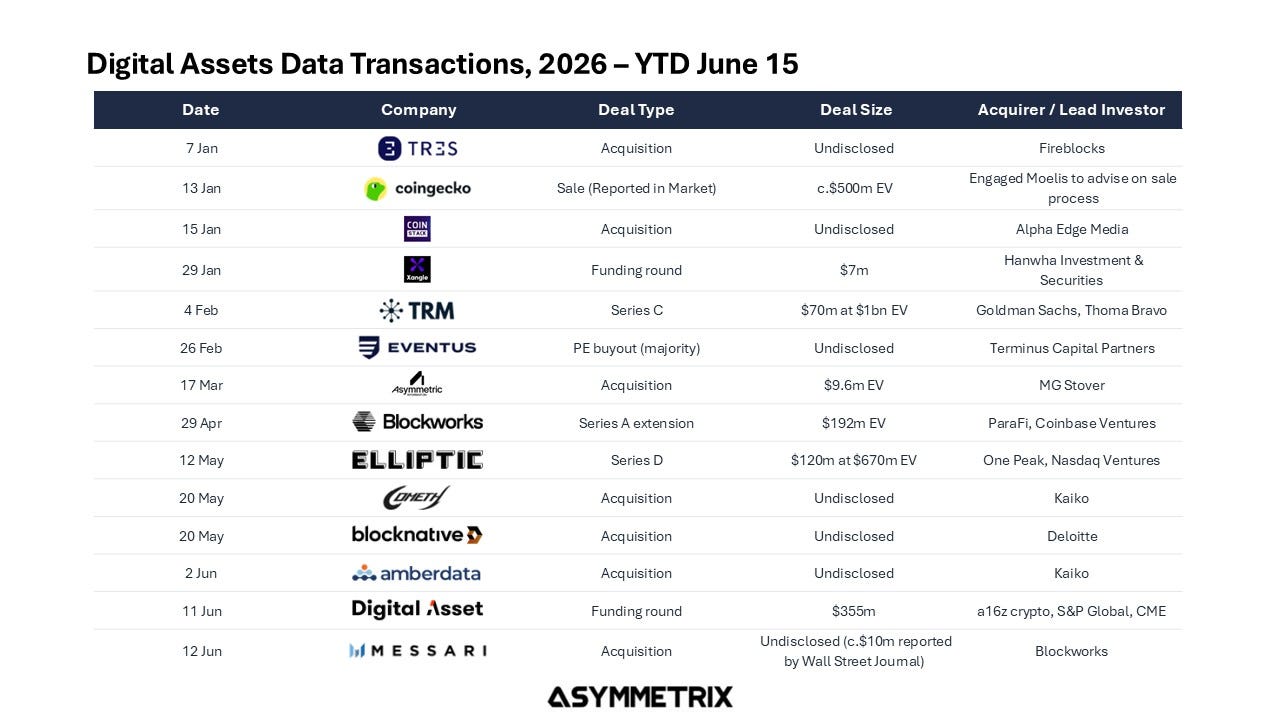
Asymmetrix tracked 18 key corporate events in the digital assets data sector during 2026 to mid-June: 11 funding rounds and 7 acquisitions, with no public listings. Disclosed total primary funding came to approximately $600m, concentrated in compliance and digital infrastructure.
The single largest round was Digital Asset’s $355m raise, led by a16z Crypto alongside a strategic syndicate that included S&P Global, CME Group, and several banks - reflecting institutional demand for tokenisation and real-world asset infrastructure. Compliance and screening were the best-funded theme: Elliptic raised $120m in a Series D at a $670m valuation, TRM Labs raised $70m in a Series C at around $1bn, and Eventus, a market surveillance platform, drew a majority investment from Terminus Capital Partners. Smaller compliance and on-chain rounds followed for Eunice ($8m), Cense (EUR6.5m), Pump.fun ($5m), and Otomato ($2m).
Merger activity was skewed toward strategic consolidation rather than pure organic scaling: Kaiko alone completed two acquisitions, Blockworks bought Messari, Deloitte acquired Blocknative, and Fireblocks acquired TRES. Where acquisition values were disclosed they were modest - consistent with a market that is resetting prices rather than halting deals.
Who’s Next? The Remaining Targets
If the direction of travel is consolidation, the question is who is next. Asymmetrix groups the most relevant remaining assets by scale, distinguishing platforms that could anchor or be anchored by a strategic buyer from specialists and bolt-ons whose value is greatest inside a larger platform.
Subscribers to Asymmetrix’s paid product have access to our take on the other assets in the sector.
Our take:
Kaiko is likely to remain acquisitive while balance sheets in the sector are weak and assets are cheap. Blockworks must now integrate Messari and prove that media, issuer tools, and data can be woven seamlessly into a single product that institutions will pay for. Compliance is likely to remain the best-funded segment, and the long tail of sub-scale, cash-consuming specialists will continue to clear at low-to-medium prices to platforms that are still buying.
Stakeholders in the digital assets data space are watching CoinGecko’s sale process closely to understand how the independent middle of the market consolidates - or whether there is any sponsor interest in the sector.
Crypto data is consolidating toward a small number of scaled, AI-ready platforms - exactly as traditional financial data did before it. The question is no longer whether crypto will have its Bloomberg, but who will build it, both organically and through acquisitions.
Last Week on Asymmetrix
Each week, Asymmetrix publishes several research reports covering companies, sectors and deals in the Data & Analytics industry - available for subscribers only.
Below are just some of the reports published in the past week:
Company Analysis - Privately-owned oil & gas intelligence provider;
Company Analysis - Ripjar;
There’s a Data Provider for That: Sporting Event Ticket Prices;
Company Analysis - FE fundinfo.
📜 Interesting Content
No.31: There’s No Hiding from AI on the Trade Show Floor - The AI Value Gap